
Spreadsheets are familiar, fast, and flexible. That’s exactly why so many companies still rely on them to run critical parts of their operations. What starts as a temporary workaround often becomes the backbone of finance, operations, reporting, and approvals. At that point, spreadsheets stop being tools and quietly turn into constraints.
Most companies do not choose spreadsheets because they are ideal. They choose them because they are available. Over time, as the business grows, these spreadsheets evolve into unofficial systems that were never designed to handle scale, accountability, or complexity. This is where the real cost begins to show.
Why spreadsheets become a problem as companies grow
In the early stages, spreadsheets feel efficient. They help teams move quickly without waiting for tools, approvals, or integrations. But once multiple people depend on the same file, once data flows in from emails, CRMs, accounting tools, and external portals, and once decisions rely on what’s inside that sheet, the risks compound.
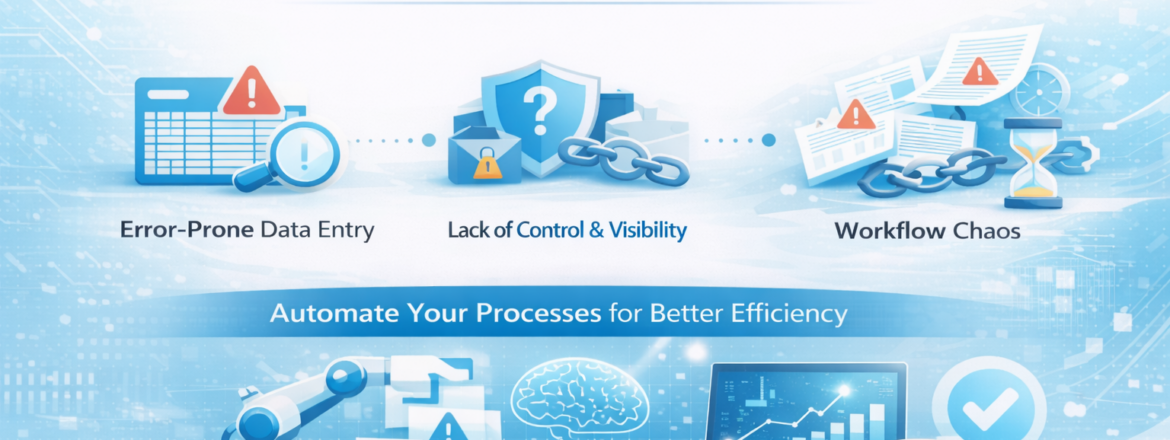
Spreadsheets were never built to be workflow engines. They lack structure, guardrails, and visibility. Changes happen silently. Versions multiply. Ownership becomes unclear. Over time, teams stop trusting the data and create parallel spreadsheets to validate each other. What was meant to create clarity ends up creating confusion.

The hidden losses of manual and spreadsheet-driven operations
The most obvious loss is time, but it rarely shows up on a balance sheet. Teams spend hours every week copying data between systems, reconciling numbers, preparing reports, chasing approvals, and fixing avoidable errors. These tasks feel small in isolation, but at scale they consume an enormous amount of productive capacity.
Errors are another quiet cost. Manual entry leads to incorrect invoices, missed follow-ups, inaccurate forecasts, and flawed reporting. Even when errors are caught, the rework damages confidence in the numbers. Decisions are delayed, or worse, made on unreliable data.
There is also a structural risk that many leadership teams underestimate. Spreadsheet-driven workflows offer little to no audit trail. It becomes difficult to answer simple questions like who approved a change, when it happened, or why a decision was made. This creates compliance exposure and weakens internal controls, especially in regulated or high-growth environments.
Customer experience suffers as well. When internal processes are manual, response times slow down. Quotes take longer to generate, onboarding drags on, issues bounce between teams, and updates are inconsistent. Customers never see the spreadsheet, but they feel its impact every time something takes longer than it should.
Perhaps the biggest loss is human potential. Skilled employees end up spending a large portion of their time on mechanical tasks that add little strategic value. This leads to frustration, burnout, and missed opportunities for innovation.

The goal is not to eliminate spreadsheets entirely
Spreadsheets still have a place. They are excellent for analysis, quick modeling, and exploratory work. The problem begins when spreadsheets become the system of record, the approval engine, or the operational workflow itself.
The real objective is to remove spreadsheets from the core execution layer of the business while preserving flexibility for analysis and planning.
How companies can move away from spreadsheets without disruption
Many automation initiatives fail because companies try to replace everything at once. A more effective approach is incremental. The focus should be on removing spreadsheets from the most critical workflows first, especially those that are repeated frequently, touch revenue or cash, or involve multiple teams.
The first step is clarity. When teams describe a workflow in plain language, without diagrams or tools, inefficiencies surface quickly. Inputs, decisions, outputs, and exceptions become obvious. This visibility alone often explains why a process feels slow or fragile.
From there, automation should start with areas where rules are clear, volume is high, and results are measurable. These early wins build confidence and demonstrate value without overwhelming the organization.

What automation with AI and RPA actually changes
Robotic Process Automation is highly effective for structured, repetitive tasks that span multiple systems. It can reliably move data between tools, handle uploads and reconciliations, trigger actions based on predefined rules, and operate consistently without fatigue.
Artificial intelligence adds value where inputs are messy or unstructured. Emails, PDFs, invoices, and free-text requests are difficult to process manually at scale. AI can extract information, classify requests, detect anomalies, and route exceptions to the right people. Instead of replacing human judgment, it reduces the manual effort required to apply it.
The most powerful results come from combining AI and RPA. AI handles understanding and interpretation, while RPA executes the structured steps. Humans are involved only where decisions or exceptions truly require them.

The business benefits go far beyond efficiency
Automation reduces execution time without increasing headcount. It improves data accuracy and consistency, which leads to better reporting and forecasting. It introduces built-in controls, approvals, and audit trails that strengthen governance rather than relying on memory and manual checks.
From a customer perspective, automation creates faster responses, clearer communication, and more predictable outcomes. Internally, it gives leadership real visibility into operations instead of fragmented snapshots from multiple files.
Most importantly, it frees teams to focus on higher-value work. Instead of managing spreadsheets, they can improve processes, serve customers better, and support growth initiatives.
A practical way to approach automation
The most effective automation programs follow a phased approach. Early efforts focus on quick wins that remove obvious friction. Once value is proven, core workflows are automated more deeply, with integrations, approvals, and dashboards. Over time, AI is layered in to handle complexity and exceptions, turning automation into a long-term operational advantage rather than a one-off project.
This approach avoids disruption while steadily reducing dependency on manual processes.

Why waiting often costs more than acting
Many companies delay automation because they believe they are too small, that their processes change too often, or that they should wait for a future system upgrade. In reality, these are the exact conditions where automation delivers the most value. Every month spent running critical workflows on spreadsheets adds operational debt that becomes harder to unwind later.
How Phenologix helps
Phenologix works with growing companies to replace manual and spreadsheet-driven workflows with reliable, scalable automation. The focus is not on tools alone, but on simplifying processes first, then applying the right mix of AI, RPA, and integrations to fit the business.
The outcome is straightforward: fewer manual steps, better control, clearer visibility, and operations that scale without constant firefighting.
Where to start
If you are unsure where automation fits, start with one spreadsheet that is updated daily, used by multiple people, and tied directly to revenue, cash, or delivery. That spreadsheet is already telling you where the friction is.
If you want, you can share a simple description of that workflow. Phenologix can help you identify the right automation path and what kind of return you can realistically expect.



Leave A Comment